

GSR EXIM is an export-focused company specializing in dehydrated onion, vegetables, and agricultural products. Based in India, we supply consistent, export-ready ingredients to global B2B buyers. With strong sourcing networks, quality-focused process...
- (+91) 8125264224
- gsrexim88@gmail.com
- Hyderabad, , BALAJINAGAR HYDERABAD, Telangana, India. 500055
© 2020 GSR EXIM. All Rights Reserved
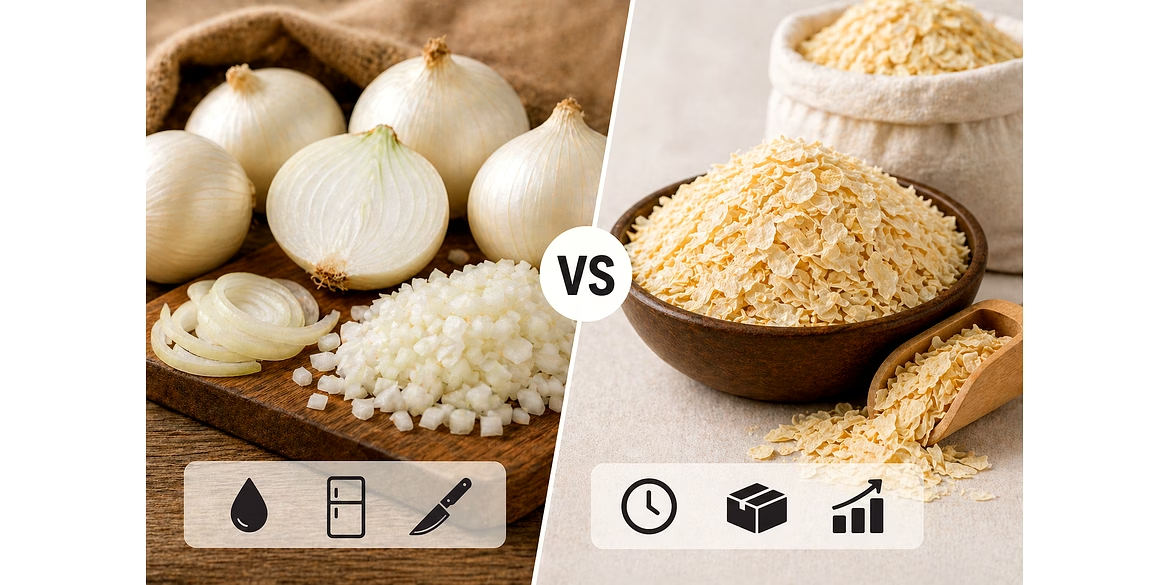

Onions are essential in food production, but choosing between fresh onion and dehydrated onion depends on processing needs, storage, and efficiency. For large-scale food manufacturing, dehydrated onion is widely used due to its consistency and ease of handling.
Overview: Dehydrated Onion vs Fresh Onion in Food Industry
Both fresh and dehydrated onions provide flavor and aroma in food products. However, their suitability varies depending on application, production scale, and logistics requirements in the food industry.
- Both options contribute flavor and aroma to food products
- Fresh onion is commonly used in traditional cooking
- Dehydrated onion is widely used in industrial food processing
- Choice depends on application, scale, and logistics
What is Fresh Onion: Characteristics and Limitations
Fresh onions are raw agricultural products with high moisture content. While they provide natural texture and freshness, they require more handling and processing before use.
- High moisture content leading to shorter shelf life
- Requires cold storage and careful handling
- Prone to spoilage during transportation
- Requires peeling, cutting, and processing before use
What is Dehydrated Onion: Features and Advantages
Dehydrated onion is processed to remove moisture, making it more stable and suitable for large-scale food production and bulk supply. It is widely used by food manufacturers and exporters.
- Low moisture content for extended shelf life
- Available in flakes, minced, kibbled, and powder forms
- Ready-to-use without additional processing
- Easy storage and transportation
Shelf Life and Storage Comparison
Shelf life and storage requirements are important considerations in food processing. Dehydrated onion provides advantages in storage efficiency and product longevity.
- Fresh onion has limited shelf life and requires controlled storage
- Dehydrated onion lasts longer when stored properly
- No refrigeration required in most cases
- Reduced risk of spoilage and waste
Cost Efficiency and Logistics Benefits
Cost and logistics play a significant role in ingredient selection. Dehydrated onion offers efficiency in bulk handling, storage, and transportation compared to fresh onion.
- Lower transportation costs due to reduced weight
- Reduced storage expenses
- Minimal product loss during transit
- Efficient handling for bulk orders
Processing Efficiency in Food Manufacturing
Food manufacturers prioritize ingredients that simplify operations. Dehydrated onion helps streamline production processes compared to fresh onion.
- Eliminates peeling and cutting requirements
- Saves labor and processing time
- Provides consistent product quality
- Easy to measure and use in recipes
Consistency and Quality in Large-Scale Production
Consistency is essential in industrial food production. Dehydrated onion ensures uniform quality, flavor, and performance across batches.
- Uniform size and quality in each batch
- Consistent flavor and aroma
- Reliable performance in recipes
- Suitable for standardized production
Applications: When to Use Fresh vs Dehydrated Onion
Both fresh and dehydrated onions have specific use cases depending on the application. However, dehydrated onion is commonly preferred in industrial settings.
- Fresh onion for immediate cooking and fresh recipes
- Dehydrated onion for processed and packaged foods
- Suitable for snacks, sauces, soups, and seasoning blends
- Preferred for bulk food manufacturing
Which is Better for Food Processing? Final Comparison
While fresh onions are essential in traditional cooking, dehydrated onion is generally the preferred option for food processing due to efficiency, cost advantages, and consistency.
- Longer shelf life and reduced waste
- Lower operational and logistics costs
- Improved production efficiency
- Consistent quality for large-scale use
FAQs: Dehydrated Onion vs Fresh Onion
Why do food manufacturers prefer dehydrated onion over fresh onion?
Dehydrated onion is easier to store, handle, and use in bulk production, with longer shelf life and reduced preparation requirements.
Is dehydrated onion as flavorful as fresh onion?
Dehydrated onion retains its natural flavor and aroma, making it suitable for various food processing applications.
Which is more cost-effective: fresh onion or dehydrated onion?
Dehydrated onion is generally more cost-effective due to lower transportation, storage, and spoilage costs.
Can dehydrated onion replace fresh onion in recipes?
Dehydrated onion can replace fresh onion in many processed and packaged food applications where consistency is required.
How long can dehydrated onion be stored?
It has a long shelf life when stored in dry conditions, maintaining flavor and quality over time.
Does dehydrated onion require refrigeration?
Dehydrated onion typically does not require refrigeration when stored in a dry environment.
What industries use dehydrated onion the most?
Food processing, ready-to-eat production, snack manufacturing, seasoning industries, and HoReCa sectors commonly use dehydrated onion.